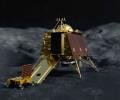
Conducting in-situ scientific experiments is underway. All payloads are performing normally, ISRO said.

The Laser-Induced Breakdown Spectroscope instrument onboard 'Pragyan' rover of Chandrayaan-3 has 'unambiguously confirmed the presence of sulphur in the lunar surface near south pole, through first-ever in-situ measurements,' ISRO said on Tuesday.

Moon's bright white glow turned crimson brick red when it delved into the dark centre of the Earth's shadow during the century's longest and darkest lunar eclipse.

ISRO on Monday said the Vikram lander successfully underwent a hop test when it made the soft-landing again on the lunar surface.

India created history on Wednesday when the lander module of Chandrayaan-3 touched down on the lunar south pole, propelling the country to an exclusive club of four and making it the first country to land on the uncharted surface.

India will become the fourth country to master the technology of soft-landing on the lunar surface after the US, China and the erstwhile Soviet Union.

Friday's mission is the fourth operational flight of LVM3 which aims to launch the Chandrayaan-3 spacecraft into a Geo Transfer Orbit.

'The ISRO has done enough simulations and also redundancies have been built in so that chances of such failure are remote. Still, we have to keep our fingers crossed'
This is the third time that Tamil Nadu has supplied the necessary soil to the Bengaluru headquartered space agency for performing the tests for its ambitious Moon missions.

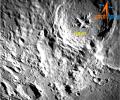
Scientists at ISRO used the orbiter high resolution camera onboard the Chandrayaan-2 orbiter to study the lunar surface hours before and after the soft-landing of Vikram lander on the moon on August 23.

Glimpses of what the historic Chandrayaan Mission discovered on the dark side of the Moon.
If it becomes a reality, the Chennai-based company will become the first private player from India to conduct such a mission to the lunar surface.

Here is ISRO's SAC Director, Nilesh M Desai explains the crucial stage of soft landing.
As scientists at the Indian Space Research Organisation (ISRO) gear up for the much-awaited soft landing of the Chandrayaan-3 spacecraft on the Moon's surface, the space agency may postpone the touchdown to August 27 in the event that health parameters of the lander module are found to be "abnormal", a senior official has said.

The entire process being autonomous when the lander has to fire its engines at the right times and altitudes, use the right amount of fuel, and scan of the lunar surface for any obstacles or hills or craters before finally touching down.
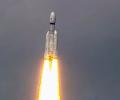
The Chandrayaan-3 mission that aims for a soft landing on the moon's surface, paving the way for future interplanetary missions, carries six payloads that would help ISRO understand the lunar soil and also get the blue planet's photographs from the lunar orbit.

Chandrayaan-3 mission's lander 'Vikram' chose a relatively flat region on the lunar surface to touch down, images captured by its camera showed.

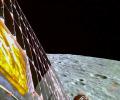
The ISRO on Monday released images of the Lunar far side area captured by the Lander Hazard Detection and Avoidance Camera (LHDAC).
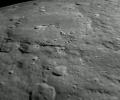
The team led by researchers from the University of Hawai'i (UH) at Manoa in the US discovered that these electrons in Earth's plasma sheet are contributing to weathering processes -- breaking down or dissolving of rocks and minerals -- on the Moon's surface.

After the successful deployment of Chandrayaan-3's lander and rover on the moon, Indian Space Research Organisation (ISRO) is hoping that their mission life will not be limited to one lunar day or 14 earth days, and that they will come back to life when the sun again rises on the Moon, to carry on with the experiments and studies there.

China on Tuesday said it will send its first-ever unmanned space probe to the Moon early next month to explore the lunar surface, a major milestone that would also be the Communist giant's maiden soft-landing on an extra-terrestrial celestial body.

It is unclear if this episode will affect or prevent the lunar lander -- which was slated to land near the moon's south pole as soon as Monday -- from attempting a touchdown.

Lander Module of Chandrayaan-3 spacecraft comprising the lander and rover has successfully separated from the Propulsion Module, Indian Space Research Organisation said on Thursday.

The Chang'e-4 spacecraft scripted history on Thursday when it made the first-ever soft landing on the far side of the moon.

Weighing 320 tonne at lift-off, the vehicle used larger strap-on motors to achieve higher payload capability.
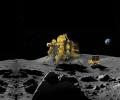
This eagerly anticipated event will be broadcast live on August 23, starting from 17:27 Hrs IST on multiple platforms, including the ISRO Website, its YouTube channel, ISRO's Facebook page, and DD National TV channel.

The initial assessment of the first-ever measurements of the near-surface lunar plasma environment over the south pole region by RAMBHA-LP payload onboard Chandrayaan-3 lander indicates that plasma there is relatively sparse, ISRO said on Thursday.
G Madhavan Nair was in Thiruvananthapuram to mark the 40th anniversary of the launching of 'sounding' rockets from the Thumba Vikram Sarabhai Space Centre.
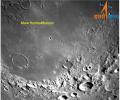
This camera that assists in locating a safe landing area -- without boulders or deep trenches -- during the descent is developed by Ahmedabad-based Space Applications Centre (SAC), a major research and development centre of ISRO.

The agency said it is currently receiving a signal from the lander, which is communicating as expected.
In a boost to the space programme, the government on Wednesday approved the Chandrayaan-4 mission to bring back moon rocks to earth, to send a spacecraft to orbit planet Venus and to expand the Gaganyaan project to build an Indian space station.

Luna-25 took off from the Vostochny launch facility in Russia's Far East, Russia-based TASS news agency reported.

Deciphering its secrets will unlock the early history of not only our planet, but also of the star system, explains Kumar Abishek.

The soft landing of the spacecraft is planned for late August. The mission is expected to be supportive to future interplanetary missions.

The Indian Space Research Organisation (ISRO) on Thursday announced that its lunar mission Chandrayaan-3 will be launched on July 14 from the space port at Sriharikota in Andhra Pradesh.

Announcing that the health of Chandrayaan-3's Lander Module is normal, ISRO on Friday said that the module has successfully undergone a deboosting (slowing down) operation, taking it closer to the Moon.
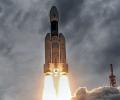
"The duration of manoeuvre was 1,738 seconds. With this, Chandrayaan-2 was successfully inserted into a Lunar orbit," Indian Space Research Organisation said.

An entire nation waited, praying and hoping fervently, as the countdown to touch down on the moon wound to a slow close on Wednesday with many thousands gathering in schools, places of worship and elsewhere and scientists doing last minute checks to ensure Chandrayaan-3 makes a soft landing on the lunar south pole.
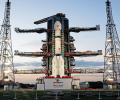
The imaging technology in Nisar can provide very high-resolution data on changes as small as one centimetre in size on the earth's surface.

The rover will carry out in-situ chemical analysis of the lunar surface during the course of its mobility.
